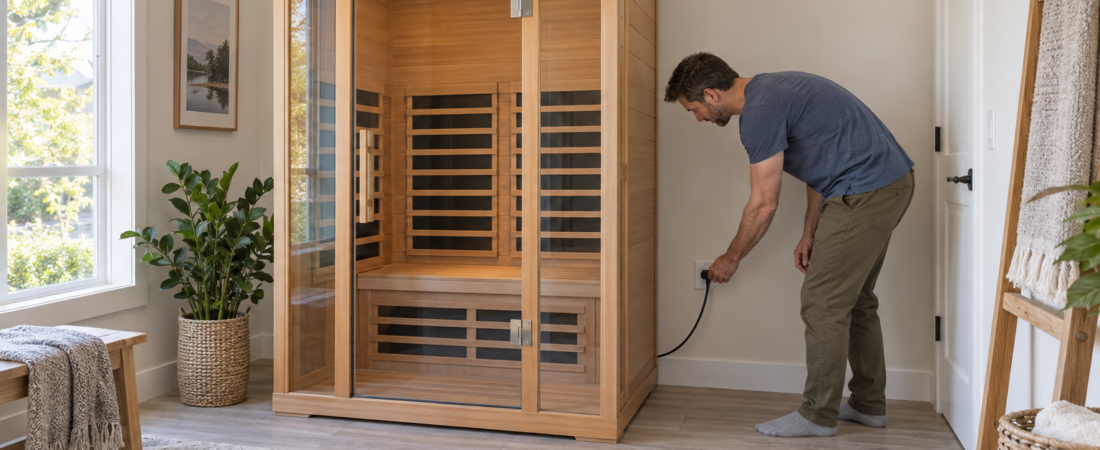
A 120-volt sauna has an obvious appeal. Instead of hiring an electrician to install a dedicated 240-volt circuit – something that might run you $300 to $800 in a straightforward installation – you may be able to use an existing household circuit and avoid that expense altogether. For someone adding a sauna to a finished basement, spare room, home gym, or garage, that can make the project noticeably simpler and cheaper.
That convenience is real, but there is an important catch: “120V” and “plug-and-play” do not always mean “plug it into any outlet you see.” Some models need a dedicated 15-amp circuit. Others need a dedicated 20-amp circuit, which may require a different receptacle. So the electrical side can be easy, though it may not be as simple as plugging in a lamp.
There is also more than one kind of 120V sauna. Most are infrared, but compact traditional saunas with an electric heater and sauna stones are available too. The better question, therefore, is not simply whether you want 120 volts. It is what kind of sauna experience you want – and how much installation work you are willing to take on.
Why homeowners look for a 120V sauna
The obvious reason is installation cost and convenience. A larger traditional sauna often uses a 240V heater and may require a new dedicated circuit, additional space in the electrical panel, and professional wiring. If the panel is nearby and has capacity, that work may be only a few hundred dollars. If the wiring run is long or the panel needs upgrading, the bill can climb well beyond that.
A 120V model may let you skip most of that. That matters especially in a finished part of the house, where opening walls or running new cable can turn a fairly simple sauna purchase into a small remodeling project.
It can also make a sauna easier to relocate later. If you decide that the home gym should become a bedroom again, a plug-in sauna is much easier to move than a unit tied permanently to a dedicated 240V installation.
120V does not always mean a normal shared outlet
This is probably the detail most likely to surprise a buyer.
A typical household circuit may be 15 amps, but some two-person saunas require 20 amps. A current two-person Cal Saunas infrared model, for example, specifies 120V/20A service. Other models operate on 120V/15A. The difference sounds small, but it matters because a 20-amp appliance may need a dedicated circuit and a NEMA 5-20 receptacle rather than the familiar 15-amp outlet found throughout most homes.
If you already have the proper dedicated circuit where the sauna will go, the electrical cost may effectively be zero. If you need an electrician to add a new 120V dedicated circuit, the job is usually still simpler and less expensive than adding a heavier 240V sauna circuit – but it is worth checking before ordering the sauna.
Before buying, verify four things: voltage, required amperage, whether the circuit must be dedicated, and the plug type. Those four lines in the specifications can tell you whether installation will really be “plug-and-play” in your house.
Infrared or traditional?
Most 120V home saunas are infrared. Infrared panels warm occupants and interior surfaces without heating the entire cabin to the temperatures common in a traditional Finnish-style sauna. That lower power demand is one reason infrared works so well on ordinary household electrical service.
If you want the classic hot-room experience – sauna stones, higher air temperature, and the ability to pour water on the stones for a burst of steam – look specifically for a traditional 120V model. They do exist, but they tend to be compact because a household circuit can only provide so much heating power.
Finnleo, for example, offers small traditional indoor saunas with 1.7- or 2.2-kW 120V heaters. Those differ quite a bit from a typical infrared cabin, even though both may plug into 120V power.
That distinction matters more than the voltage. Someone who loves a traditional sauna may be disappointed by infrared even if the installation is wonderfully easy. Someone whose priority is relaxation, warmth, and convenience may be perfectly happy with infrared and never miss the larger 240V heater.
The tradeoff: simplicity versus heating power
A 120V circuit limits how much power the sauna can draw. A larger traditional sauna might use a 6-kW or 8-kW 240V heater. By comparison, a small 120V traditional heater may be around 1.7 to 2.2 kW. That is a major difference in heating capacity.
The practical result is usually a smaller enclosure and, in some cases, a longer warm-up time. That is not necessarily a problem for a one- or two-person sauna. It simply means 120V makes the most sense when the sauna itself is appropriately sized for the available power.
You can also get a modest operating-cost advantage because the heater is smaller. A 1.7-kW heater running for one hour uses 1.7 kilowatt-hours of electricity. At an electricity rate of 15 to 20 cents per kilowatt-hour, that works out to roughly 26 to 34 cents for that hour of full-power operation. Actual use varies because heaters cycle on and off once the sauna reaches temperature.
What size makes the most sense?
For most homeowners shopping specifically for 120V, we would start with one- and two-person models.
That is where the electrical simplicity and the physical size tend to line up best. These models can fit in bedrooms, home gyms, basements, finished garages, and other spaces where a larger traditional sauna might be difficult to accommodate.
Do not rely too heavily on the manufacturer’s “one-person” or “two-person” label. Look at the actual interior dimensions and bench width. Two saunas advertised for two people can feel dramatically different once two adults are sitting inside. If you expect to use it primarily alone, buying a roomy two-person model may be more comfortable than choosing the smallest cabin that technically fits one person.
What should you expect to spend?
One thing that surprised us when looking at this category is that 120V does not necessarily mean inexpensive.
Entry-level infrared cabins can start in the low thousands of dollars, while better-built two-person systems can cost several thousand. Premium models add higher-grade wood, better controls, lighting, audio, app connectivity, and more sophisticated infrared heating systems. Traditional 120V saunas can also command premium prices because the enclosure, benches, heater, controls, and construction quality matter far more than the voltage printed on the specification sheet.
The real savings may therefore come from installation rather than from the sauna itself. If a $4,000 120V sauna avoids $500 or $800 of electrical work that a similarly priced 240V model would require, the difference in total installed cost becomes meaningful.
Questions to answer before buying
Before ordering a 120V sauna, we would want clear answers to these questions:
- Is it infrared, traditional, or a hybrid?
- What amperage does it require?
- Does it need a dedicated circuit?
- What plug and receptacle does it use?
- What is the maximum operating temperature?
- How long does it typically take to warm up?
- What are the exact exterior and interior dimensions?
- Is the sauna delivered assembled, in panels, or as a kit?
- What warranty covers the heaters, controls, and wood structure?
- Who handles replacement parts and warranty service?
Those answers will tell you far more than the phrase “plug-and-play.”
What kind of 120V sauna would we choose?
For a homeowner whose top priority is easy installation, we would start with a well-supported one- or two-person infrared model that runs on a standard 120V dedicated circuit. The attraction is straightforward: modest space requirements, no major electrical project, and a relatively simple installation.
If you want traditional sauna heat and stones, we would narrow the search to smaller 120V traditional models and accept the tradeoff: a more compact enclosure and less heating power than a larger 240V sauna.
In either case, we would give extra weight to a manufacturer that publishes clear electrical specifications, stocks replacement parts, and provides direct customer support. On a purchase costing several thousand dollars, good support matters more than another decorative feature.
Before buying, compare this simpler installation path with the broader 120V-versus-240V tradeoffs, confirm the home’s electrical requirements, and measure the available room and access path.
The bottom line
A 120V sauna can be an excellent choice if you want to add a sauna without turning the installation into a remodeling project. Avoiding a new 240V circuit can save several hundred dollars and, just as importantly, eliminate one more contractor from the project.
Just remember that 120V is not a complete specification. Amperage, circuit requirements, sauna type, size, and heating performance all matter.
For many buyers, the sweet spot is a compact one- or two-person unit that can run on a dedicated 120V circuit in a room they already have. If that matches your space and the sauna experience you want, the electrical simplicity can be worth considerably more than having the largest heater available.
For most homeowners, the right 120-volt sauna balances easy installation with the kind of heat and experience they actually want. If avoiding electrical work is a priority, 120 volts can be a very practical place to start—but it is still worth checking the circuit requirements, room size, and sauna type carefully before you buy.
Sources consulted
Cal Saunas, 2-person infrared sauna owner’s manual (120V/20A): https://calsaunas.com/pdf/owners-manual/Solara-2.pdf
Finnleo NorthStar 4×4 indoor sauna specifications (120V traditional heater): https://sfspas.com/saunas/4-x-4-northstar-indoor-sauna/
Finnleo IS440 specifications (120V infrared/hybrid models): https://www.nespas.com/saunas/is440/
Architectural Digest review of Plunge Infrared Sauna (120V/20A example): https://www.architecturaldigest.com/story/plunge-infrared-sauna-review