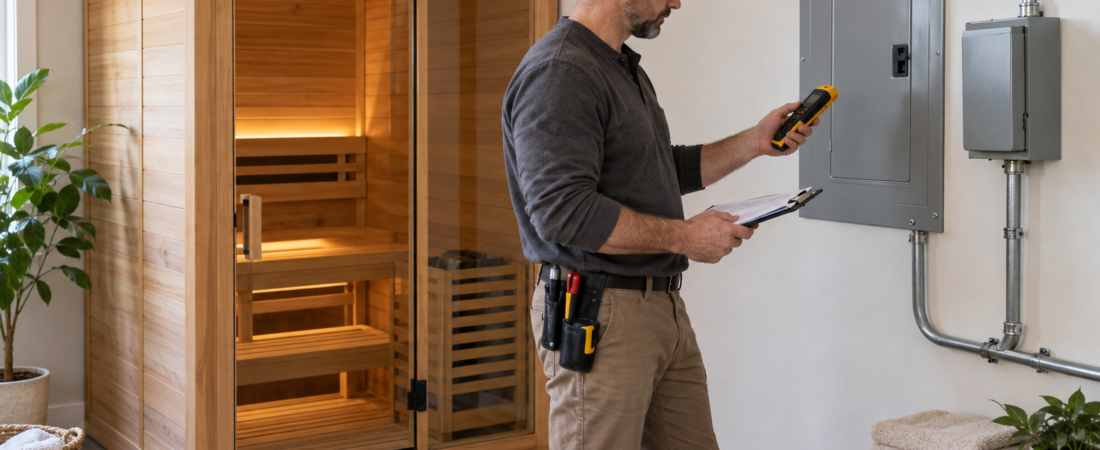
Sometimes very little. Sometimes several thousand dollars’ worth. The electrical side of a home sauna depends mostly on the type of sauna you buy, the heater size, where the sauna will sit, and what capacity your home’s electrical panel already has.
That is why you should check electrical requirements before you choose a model. A $4,000 sauna can remain a $4,000 project if the wiring is simple, or become a much more expensive project if the house needs a long new circuit or a panel upgrade.
The easiest case: a 120-volt sauna
Many compact infrared saunas, and a smaller number of traditional sauna products, operate on 120 volts. That can eliminate the need to install a new 240-volt circuit.
But ‘120 volt’ does not automatically mean ‘plug it into any outlet.’ A sauna may require a dedicated 15- or 20-amp circuit, and the manufacturer may prohibit sharing that circuit with other appliances. If the closest outlet already serves lights, a freezer, tools, or other loads, an electrician may still need to add a dedicated circuit.
The practical advantage is that adding or extending a 120-volt circuit is usually simpler than installing a high-amperage 240-volt sauna circuit.
Most traditional electric saunas use 240 volts
Once you move into a traditional sauna with an electric stone heater, 240-volt service becomes much more common. A typical two- to four-person home sauna might use a heater in the 4.5 to 8 kW range.
For example, Harvia currently offers residential heaters from 4.5 kW through 9 kW and higher. A 6 kW heater is a very common size for a modest home sauna, while larger rooms may call for 7.5 or 9 kW.
The exact breaker, wire size, and controls depend on the heater and installation instructions, so this is not a place to guess. Give the heater manual to the electrician before quoting the work.
What might a straightforward 240-volt installation cost?
For planning purposes, roughly $300 to $800 is a reasonable allowance for a straightforward dedicated 240-volt sauna circuit when the electrical panel has capacity and is reasonably close to the sauna.
That could include the breaker, appropriately sized cable, labor, and the connection or disconnect equipment required by the particular installation. Local permit requirements can add to the cost.
A short run from a panel in the garage to a sauna a few feet away may land toward the lower end. Running heavy cable across a finished basement, through multiple walls or to the opposite side of the house can cost considerably more.
The expensive case: the panel does not have enough capacity
The bigger concern is usually not the sauna circuit itself. It is discovering that the existing electrical service cannot comfortably accept another substantial load.
If a home has an older 100-amp panel that is already heavily loaded, an electrician may recommend a service or panel upgrade before adding a 6-, 8-, or 9-kW sauna heater.
A full electrical-panel or service upgrade can easily add roughly $2,000 to $5,000 or more, depending on the house, utility requirements, permit costs, and whether the meter or service entrance also needs work.
That does not mean every older house needs an upgrade. A proper load calculation is what matters. Two houses with identical 100-amp panels can have very different available capacity depending on whether they use gas or electric heat, electric water heating, EV charging, and other large loads.
Hardwired heater or outlet?
Traditional sauna heaters are frequently hardwired rather than plugged into a receptacle. Some also use a separate control panel, temperature sensor, lighting circuit, or Wi-Fi control system.
That means the electrical work may involve more than simply placing a 240-volt outlet on the wall. The installer may need to mount a control box, route sensor wiring, install a disconnect, and coordinate the final connection after the sauna is assembled.
Ask these questions before buying
• What voltage does the sauna require?
• What is the heater’s kW rating?
• What breaker size does the manufacturer specify?
• Does the heater need to be hardwired?
• Does the sauna require a separate 120-volt circuit for lighting or controls?
• How far is the planned sauna location from the electrical panel?
• Does the panel have physical space and electrical capacity for the new load?
A useful way to budget the project
If you have not yet had an electrician look at the house, I would keep three possible electrical budgets in mind:
• 120-volt sauna using an existing suitable circuit: potentially little or no additional electrical cost.
• Straightforward new dedicated 240-volt circuit: roughly $300 to $800 as a planning range.
• Panel/service upgrade plus sauna circuit: potentially $2,500 to $5,000 or more.
Those are planning numbers, not quotes. The purpose is to prevent the electrical side of the project from becoming an unpleasant surprise after the sauna has already been ordered.
For more context before choosing a model, compare 120V and 240V saunas, learn what “plug-and-play” really means, and measure the space available for installation.
The bottom line
For many homeowners, sauna electrical work is a manageable part of the project rather than a deal breaker. The easiest installations are homes with a nearby panel, available capacity, and a clearly specified heater.
The simplest rule is to identify the sauna you are seriously considering, download its electrical requirements, and let an electrician price that exact installation before you buy. Spending a little time on that step can tell you whether the sauna needs a $400 circuit—or whether the house is about to turn it into a much larger project.
Sources and further reading
Harvia — residential electric sauna heaters and technical requirements: https://www.harvia.com/en-US/products/
Harvia KIP 6.0 kW 240V residential heater: https://www.harvia.com/en-US/products/JH60WU1MUL/kip60w-60-kw-240v-black
Harvia Virta Wall heater family (4.5–9 kW): https://www.harvia.com/en-US/products/HLWE604M/virta-wall-hlw60e-60-kw