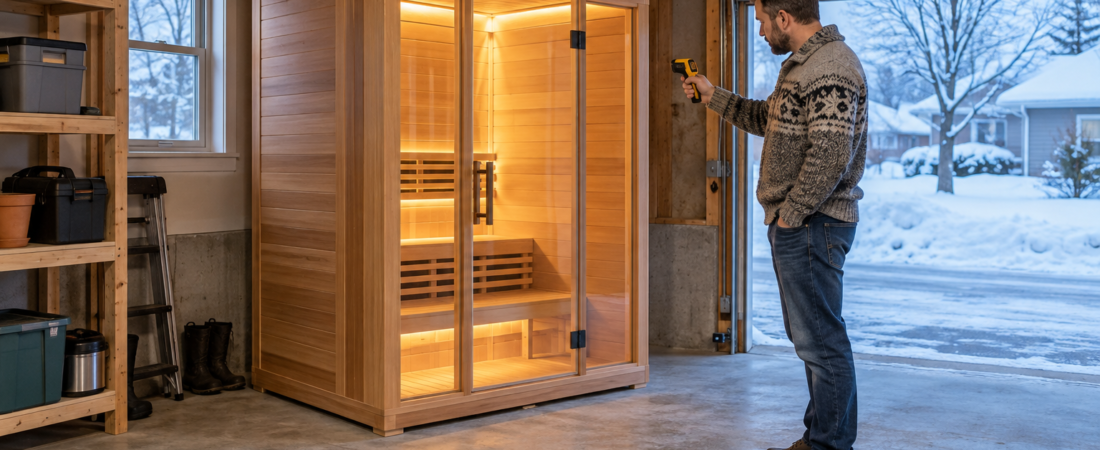
Yes—often you can. An unheated garage can be a perfectly workable place for an indoor sauna, and for some homeowners it is one of the easiest places to fit one. But an unheated garage changes a few things: how long the sauna takes to warm up, how much heat it loses, how you handle moisture, and whether the sauna was designed to live in that environment.
The biggest mistake is assuming that because the sauna gets hot, the surrounding garage temperature doesn’t matter. A sauna heater is sized for a certain room volume and a reasonably insulated enclosure. If the sauna starts at 35°F instead of 65°F, it has much more work to do before the room reaches bathing temperature.
Start with the sauna manufacturer’s requirements
Before anything else, check the installation and operating requirements for the exact model you are considering. Some indoor sauna kits are intended for conditioned indoor spaces, while others tolerate a much broader range of surrounding temperatures.
This matters especially with infrared saunas, which contain electronic controls, wiring, displays, and heating panels. Traditional saunas are mechanically simpler, but their heater controls and other electrical components still have temperature limits.
For example, Harvia lists some residential heater equipment for indoor wet-area use and publishes storage-temperature limits for its controls and heaters. The practical lesson is simple: do not assume that an ‘indoor sauna’ automatically means ‘safe in a freezing garage.’ Check the manual before buying.
How cold is too cold?
No single temperature applies to every sauna. A garage that occasionally drops into the 40s is a very different environment from an unattached garage that spends January below freezing.
If your garage stays above freezing most of the winter, many well-insulated traditional sauna kits should operate there, although warm-up time will increase. If the garage regularly reaches 20°F or below, I would be much more selective about the model and would want the manufacturer to confirm that the controls, heater, and other components are suitable for those conditions.
Expect a longer warm-up
Cold starting temperatures do not necessarily prevent a traditional sauna from working, but they can make patience part of the routine.
Suppose a sauna normally needs 35 to 45 minutes to warm from a 65°F room to roughly 175°F. Starting in a 35°F garage gives the heater another 30 degrees of temperature difference to overcome before it even reaches the same starting point.
That doesn’t mean warm-up time increases in a perfectly straight line, but it wouldn’t be surprising for a cold-weather garage installation to add 10, 20, or even 30 minutes on especially cold days. The sauna’s insulation quality, the amount of glass, the heater size, and how tightly the door seals will all matter.
Insulation matters more in a garage
If I were choosing between two garage saunas, I would put more weight on insulation and construction quality than I would for the same sauna in a finished basement.
A sauna surrounded by 70°F conditioned air loses less heat than the same sauna sitting in a 30°F garage. More glass can also increase heat loss. A heavily glazed sauna may look terrific in a showroom, but a more enclosed, well-insulated model may be the better choice for a cold garage.
Traditional electric saunas are probably the safer bet
For an unheated garage, I would generally lean toward a traditional electric sauna rather than making an infrared model my first choice.
Traditional electric saunas are built around a relatively straightforward combination of insulated walls, benches, a heater, and sauna stones. A properly sized 6 kW or 8 kW heater has substantial heating capacity, and manufacturers such as Harvia size heaters according to sauna-room volume.
An infrared sauna can certainly work in a garage, but because it relies more on electronic controls and panels—and often operates at lower total power—I would want clear manufacturer approval for cold-space use.
You may still need 240-volt electrical service
Most traditional garage saunas large enough for two or more people will require a dedicated 240-volt circuit. As we discussed in the 120V article, adding a straightforward 240-volt sauna circuit might cost roughly $300 to $800, although long wire runs, difficult access, or panel work can push the cost higher.
If the existing electrical panel is in the garage, that can actually make the installation easier and cheaper than putting the same sauna in a distant part of the house. On the other hand, an older garage with limited electrical capacity may turn a simple sauna project into a larger electrical project.
Moisture still has to go somewhere
A garage may feel less delicate than a finished room, but moisture management still matters.
With a traditional sauna, water poured over the stones creates humidity. People also bring moisture out of the sauna on towels, skin, and wet flooring. After use, the sauna needs to dry. In a garage that already has condensation problems, poor airflow, or damp concrete, I would address those issues before adding another moisture source.
That does not necessarily mean installing an elaborate ventilation system. Depending on the garage, opening the garage door briefly after use, operating an exhaust fan, or using a dehumidifier may be enough. The goal is simply to avoid trapping warm, moist air in a cold space where it can condense on walls, windows, tools, or stored belongings.
Watch for frozen pipes and other garage realities
The sauna may not be the only thing affected by the heat and humidity. Think about what else shares the garage.
• Paint, chemicals, gasoline, and other flammable materials should not be stored close to the sauna or heater.
• If the garage contains plumbing, repeated temperature swings and condensation deserve attention.
• A vehicle parked close to the sauna can bring in snow, road salt and moisture.
• If the floor slopes toward a garage door or drain, make sure the sauna sits level and stable.
• Do not block electrical panels, doors, attic access, or required clearances.
What about warming the garage itself?
You do not necessarily need to heat the entire garage just to use the sauna. But in a very cold climate, keeping the garage at even 40°F to 50°F instead of letting it fall into the teens can make the sauna easier to use and may be kinder to its electronics.
That could be as simple as modest background heat during the coldest weather. Whether that makes economic sense depends on the garage size, insulation, and climate.
A garage can actually simplify installation
Despite all these cautions, garages have some real advantages.
• Concrete floors are usually more forgiving than finished interior flooring.
• Electrical panels are often nearby.
• There may be enough open wall space for a modular sauna kit.
• You do not have to give up bedroom or basement living space.
• Minor heat and humidity are less disruptive than they might be in a finished room.
For someone with a two-car garage who only needs part of one bay, a compact two-person sauna can take up surprisingly little floor area while leaving most of the garage usable.
What would we look for in a garage sauna?
For an unheated garage, I would prioritize practical construction over showroom features.
• Good insulation and tight-fitting doors.
• A traditional electric heater sized generously for the sauna volume.
• Clear manufacturer approval for the expected surrounding temperature range.
• Limited unnecessary glass if the garage gets very cold.
• Straightforward ventilation and drying.
• A warranty that does not exclude the intended installation environment.
If two models were otherwise comparable and one manufacturer clearly said its unit was appropriate for garage installation while the other was vague, I would choose the one with the clearer guidance even if it cost a little more.
If the garage remains your preferred location, continue with our guide to choosing a sauna for a garage, then check the likely electrical requirements and how cold conditions can affect operating costs.
The bottom line
An unheated garage can be a very good place for a home sauna, but the colder the garage gets, the more important insulation, heater capacity, and manufacturer specifications become.
If the garage stays reasonably dry and above freezing most of the time, a well-built traditional sauna may need little more than a suitable electrical circuit and enough time to warm up. If the garage regularly drops well below freezing, verify the sauna’s allowable operating and storage temperatures before buying and expect longer warm-up times.
The garage doesn’t have to become a heated room to be a useful sauna space. It simply needs a sauna that was chosen with the garage—not just the sauna showroom—in mind.
Sources and further reading
Harvia — residential electric sauna heaters and heater sizing information: https://www.harvia.com/en-US/products/
Harvia — published technical specifications and storage-temperature limits for residential heater equipment: https://www.harvia.com/
Saunafin — sauna kit installation and rough-in resources: https://www.saunafin.com/resources/sauna-material-kits