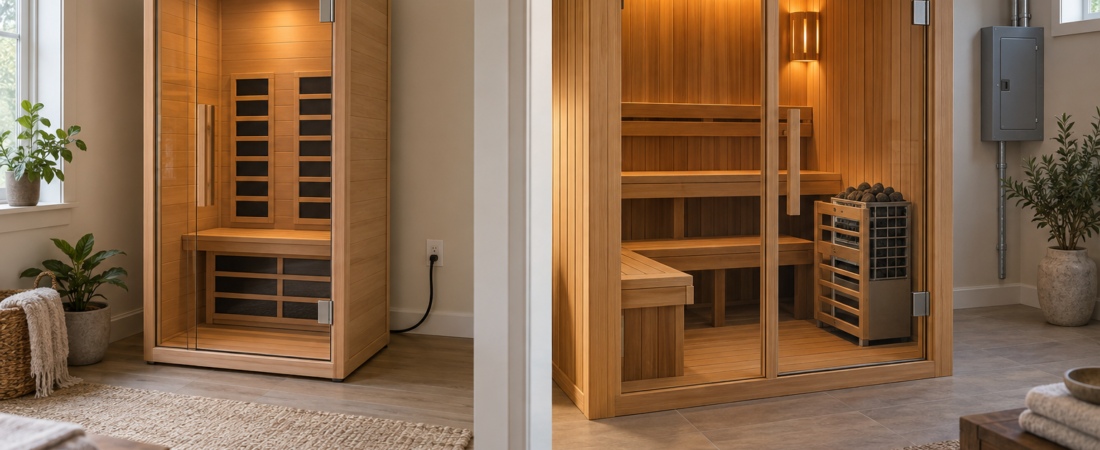
A 120-volt sauna sounds easier, and often it is. If the model can use a circuit you already have, you may avoid hiring an electrician to install a dedicated 240-volt line—work that can easily add anywhere from $300 to $800 to the project in a straightforward installation. But voltage is not just an installation detail. It usually tells you about the sauna’s size, the type of heat it uses, and how quickly it can heat up.
The practical question is not simply whether 120V or 240V is better. It is whether the easier electrical setup of a 120V model is worth the trade-offs for the kind of sauna experience you want.
What 120V usually means
Many one- and two-person infrared saunas are designed for 120-volt household power. That can make them attractive for a bedroom, basement, finished garage, home gym, or other indoor space where adding new electrical service would be inconvenient.
But ‘120V’ does not always mean ‘plug it into any outlet.’ Some larger 120V infrared models require a dedicated 20-amp circuit and a 20-amp receptacle. Sunlighten, for example, specifies a dedicated 120V/20A circuit for several of its Signature and Amplify models. Other smaller infrared models may run on a standard 15-amp household circuit.
So even with a 120V sauna, check the manufacturer’s exact amperage and circuit requirements before assuming you won’t need electrical work.
What 240V usually means
Traditional electric saunas are much more likely to use 240 volts. A conventional sauna heater has to heat the air, the wood surfaces, and a mass of sauna stones, so it generally needs substantially more power than a small infrared cabin.
A compact traditional sauna with a 6 kW heater may require a dedicated 240V, 30-amp circuit and hardwired connection. Larger residential heaters commonly move into 40-amp territory or beyond. Almost Heaven, for example, lists a 6 kW heater in its two-person Salem barrel sauna as 240V, 30 amps, hardwired. Saunafin says most residential electric sauna heaters require 30- or 40-amp breakers, depending on heater size.
That extra electrical work is not necessarily a reason to avoid 240V. It is simply part of the real cost of getting a traditional sauna experience.
The biggest difference is usually the sauna experience
Voltage by itself does not determine whether a sauna is infrared or traditional, but in the home market the two often travel together: smaller 120V models are commonly infrared, while traditional stone-heater saunas are commonly 240V.
If what you want is a room that climbs toward traditional sauna temperatures, with a heater full of stones and the option to add water for bursts of steam, 240V is usually where you will end up.
If your priority is easier installation, lower electrical demand, and the gentler heat of an infrared cabin, a 120V model may be the more practical choice.
Does 240V heat faster?
Usually, yes—because the heater can draw much more power. That does not mean every 240V sauna beats every 120V sauna, since room size, insulation, heater design, and ambient temperature all matter. But a properly sized 240V traditional heater is built to bring an entire sauna room to a high temperature.
For example, Almost Heaven says its 6 kW Salem barrel sauna can reach about 194°F in roughly 45 to 60 minutes. A smaller infrared sauna works differently: its panels are designed to warm the user more directly, so comparing warm-up time alone can be misleading.
What does the electrical upgrade really cost?
For planning purposes, roughly $300 to $800 is a reasonable allowance for a relatively straightforward dedicated 240V sauna circuit. The actual cost can be lower or much higher depending on how far the sauna is from the electrical panel, whether the walls are finished, the required amperage, local labor rates, and whether the panel has room for another breaker.
If the electrical panel itself needs an upgrade, you could be looking at anywhere from $2,000 to $5,000 depending on the existing service and local labor costs. That is why it makes sense to have an electrician look at the proposed sauna location before buying an expensive 240V model.
Do not forget that some 120V saunas still need an electrician
This is the part that can surprise buyers. A home may have plenty of ordinary 120V outlets, but a sauna that requires a dedicated 20-amp circuit may not be able to share an existing bedroom or basement circuit with lights, televisions, refrigerators, or other loads.
If the correct dedicated circuit isn’t already available, you may still need electrical work—generally less involved than installing a higher-amperage 240V circuit.
A simple way to choose
Choose 120V first if you value easy installation, are looking at a smaller one- or two-person sauna, prefer infrared heat, or want to avoid adding a 240V circuit if possible.
Choose 240V first if you specifically want a traditional sauna with hot stones and löyly, want higher room temperatures, are buying a larger cabin, or care more about the sauna experience than minimizing installation work.
There is nothing inherently superior about one voltage. They are usually serving different buyers.
For the next step, review the broader electrical-installation guide, learn what to expect from a 120V plug-and-play sauna, and compare infrared and traditional heat.
The bottom line
For a homeowner who wants the simplest route to having a sauna in the house, 120V can be very appealing. It may save several hundred dollars in electrical work and can make installation much less complicated.
But if the reason you want a sauna is the traditional experience—high room temperatures, hot stones, and steam from water poured over those stones—the added cost of a 240V circuit may be money well spent.
Before choosing either one, check the exact circuit and amperage requirements of the model you are considering and compare the total installed cost, not just the price printed on the sauna. A less expensive sauna that requires unexpected electrical work can quickly stop being the less expensive choice.
Sources consulted
Sunlighten Signature and Amplify electrical specifications: https://shop-us.sunlighten.com/collections/saunas
Almost Heaven Salem 2 Person Barrel Sauna specifications: https://almostheaven.com/products/salem-2-person-barrel-sauna-kit
Saunafin residential sauna electrical FAQ: https://www.saunafin.com/faqs/general
Dynamic Saunas electrical FAQ: https://dynamic-saunas.com/