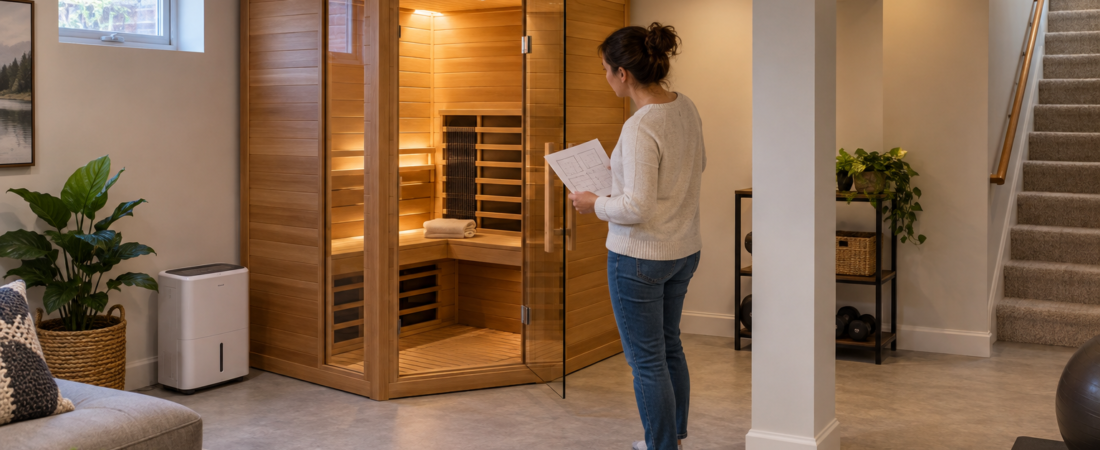
A basement can be one of the best places in a home to install a sauna. It is protected from the weather, usually offers more privacy than the main living areas, and often has concrete flooring that can tolerate heat and moisture better than finished hardwood or carpet.
But not every sauna advertised for indoor use is automatically a good basement sauna. Before choosing one, consider five things: available space, ceiling height, electrical service, ventilation and moisture, and the type of sauna experience you want.
Traditional or infrared?
The first decision is whether you want a traditional sauna or an infrared sauna.
A traditional sauna uses an electric heater and sauna stones to heat the room. Most traditional home saunas operate on 240-volt electrical service and can reach temperatures around 180°F or higher. You can usually pour water over the heated stones to create bursts of steam, or löyly.
An infrared sauna heats the occupants primarily through infrared panels rather than heating the entire room to traditional sauna temperatures. Many smaller infrared models run on standard 120-volt household power.
Neither is automatically better for every homeowner. The important question is which experience you actually want. If you want a traditional hot-room sauna experience with heated stones and steam, focus on traditional electric saunas. If avoiding electrical work and having an easier installation matter more, a 120-volt infrared model may be worth considering.
Check your electrical service before choosing the sauna
Electrical requirements are one of the easiest things to overlook.
Larger traditional electric saunas commonly require a dedicated 240-volt circuit and professional hardwiring. Current indoor models from major manufacturers use heaters ranging from about 6 kW to 8 kW and may require 30- or 40-amp 240V circuits.
That doesn’t necessarily make installation difficult, but it can add considerably to the project’s cost if your basement doesn’t already have suitable service nearby.
Questions to answer first
- Is 240V service available near the planned location?
- Is there room in the electrical panel for another circuit?
- How many amps does the sauna heater require?
- Does the heater need to be hardwired?
- Does lighting or another accessory require a separate 120V outlet?
Getting those answers first can prevent you from buying a sauna that turns into an unexpectedly expensive electrical project.
Do not ignore basement ventilation and moisture
This is especially important with traditional saunas.
Even though the sauna itself is enclosed, heat and moisture eventually enter the surrounding basement. If you pour water on hot sauna stones, that moisture has to go somewhere.
An unfinished basement with concrete floors may make moisture management easier, but it does not eliminate the issue. Ideally, your location should let the sauna and surrounding room dry properly after use. Depending on the setup, that may mean mechanical ventilation, an operable window, nearby exhaust ventilation, or simply enough air circulation in a properly conditioned basement.
Measure the basement – including the route into it
Do not just measure the spot where the finished sauna will sit.
- Ceiling height: Some indoor sauna kits are nearly 7 feet tall once assembled.
- Floor dimensions: Leave enough room for the door to operate and for any manufacturer’s required clearances.
- Stairways and doorways: The sauna may arrive as panels or large components that need to make it downstairs.
- Utility obstacles: Pipes, ductwork, support posts, water heaters, and electrical panels can turn an apparently large basement area into a surprisingly awkward installation space.
One advantage of modular indoor sauna kits is that they are specifically designed to be assembled inside existing rooms. Rectangular indoor models can work especially well in basements, home gyms, and bathrooms because they use wall and corner space efficiently.
How much should you expect to spend?
There is an enormous range.
A small infrared sauna can cost considerably less than a traditional sauna with a quality electric heater. For a well-built traditional indoor sauna, several thousand dollars is a more realistic starting point, while larger or more premium installations can go substantially higher.
The important point is that the sauna’s advertised price is not necessarily the total project cost. Depending on your house, you may also need electrical work, ventilation, flooring preparation, insulation or moisture management, delivery, assembly, or minor carpentry.
What kind of basement sauna would we choose?
For most homeowners who want a traditional sauna without a full construction project, we would start with a rectangular modular indoor sauna with an electric stone heater.
Why rectangular? Basement space is usually valuable. A rectangular enclosure generally uses corners and walls more efficiently than a barrel-shaped sauna.
We would also favor a model with:
- a reputable electric heater
- clear electrical requirements
- straightforward ventilation provisions
- readily available replacement parts
- manufacturer support
- enough interior height and bench space to provide a comfortable sauna experience
For homeowners who don’t want to add 240V electrical service, a quality 120V infrared sauna is the easier alternative, though it offers a different experience.
For a complete basement plan, compare this buying guide with our articles on unfinished-basement installation, space and access, and electrical requirements.
The bottom line
A basement is often an excellent location for a home sauna, but choose the sauna after evaluating the room, not before.
- Measure the available space.
- Check your electrical service.
- Decide between traditional and infrared.
- Plan how heat and moisture will leave the area.
- Establish your total installation budget – not merely the purchase price.
Once you know the space, electrical service, sauna type, moisture plan, and total installation budget, choosing the actual sauna becomes considerably easier.
The Home Sauna Project will compare specific basement-friendly models by size, electrical requirements, sauna type, price, and installation difficulty so homeowners can narrow the field before spending thousands of dollars.